


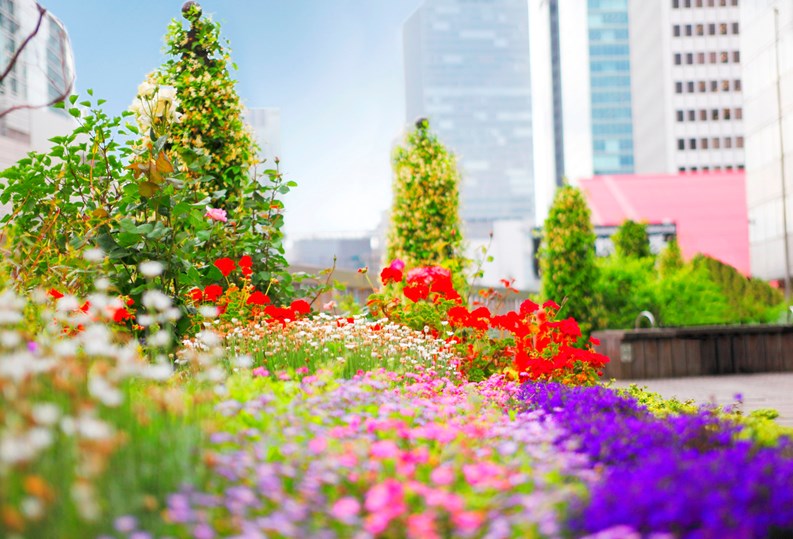
Over the past few decades, ideas and technologies for improving energy efficiency, reducing ecological impact, and providing additional amenities to residents in multifamily buildings have surged. Near the front of that pack has been the ‘green roof’—a rooftop that’s more than just a shield from the elements, but also an energy source, an oasis for wildlife, and often a valuable outdoor amenity space for city dwellers.
That said, while green roofs look good and make people feel good, some experts believe that in many cases, their energy efficiency and savings have not totally lived up to expectations—or balanced out the cost of their installation and maintenance. Let’s take a look at the benefits and potential drawbacks of green roofs in a residential context.
Taming the Heat Island
Urban environments display a phenomenon known as the ‘heat island effect.’ Stated simply, the dense concentration of buildings and people, plus the heat-absorbing properties of the materials used to build those buildings, plus the added element of vehicles emitting exhaust, plus the lack of cooling vegetation in urban environments all combine to make those environments much warmer than the surrounding less-dense environments with fewer cars and more natural greenery. Hence, the ‘heat island’.
According to engineers, the concept of green roofs was initially developed to battle this deadly combination. Living foliage reduces the surface temperature of the roof, thereby lowering cooling loads, which in turn reduces the need for air conditioning inside the building.
And there’s more. Green roofs may qualify for state and local tax credits to help offset the cost of installation; they also add value for residents as usable outdoor amenity space. They’re even good for wildlife. New Jersey is on a major migration path for many birds, and landscaped roofs offer them a resting place en route.
Real Life vs. Expectations
While green roofs have proven to be an asset in the fight against heat islands, and while the aforementioned tax breaks can be helpful, the question remains as to how effective they really are relative to the cost of installing and maintaining them. There are also questions about how viable they are for older buildings that would require extensive structural work to even make the installation of a green roof possible.
“To begin with,” notes David Kent, a director with the Falcon Group, a national engineering consultancy based in Warren, New Jersey, “in properties with large roofs and dark-colored roof membranes, the solution became to create green spaces like vegetative roofs to reduce that increasing heat island effect. For a while, everything was built around this concept without empirical evidence. But truthfully, today this problem can be otherwise regulated with even newer technologies, like low reflective membranes” that reduce heat transfer into the building.
Many pros point out that realistically, the savings from ‘greening’ the roof of a multifamily high-rise in a densely-built city fall into a fairly modest range overall, even though the effect on cooling load can be more substantial. For example, the Environmental Protection Agency (EPA) notes that a vegetated roof covered with live plants might save a building community between 1-10% on their annual energy costs.
Similarly, according to the Green Building Alliance, a ‘cool roof’—one with a white or reflective coating to reduce heat absorption—might cut cooling costs between 2-15%, but could actually raise heating costs slightly in northern cities, cutting into the warm-weather savings.
Those modest savings are because the roof represents only a percentage of the building envelope. In tall buildings, the cooling-energy benefit of a green roof decreases as building height increases, because the roof affects fewer apartments relative to total floor space. So taller buildings might expect savings on the lower end of the aforementioned ranges, while low-rise buildings could recoup more.
“People wanted, hoped, that green roofs would be a panacea,” says Kent, “but it wasn’t. In many cases, green roofs have become more of a beautification technique. Now, it’s really a utilization of space issue.”
Green, Get the Money
Green roofs also come with some logistical and cost issues for many boards and building owners. “In new construction,” says Melissa Barrows-Leib, president of Mac Brady Associates, a roofing consultant based in Hillside, Illinois, “the structural support needed to take on the weight of a green roof must be part of the initial design, and that can add cost to the project. In existing buildings, a structural engineer is needed to evaluate the existing structure to determine if it can take on additional weight and/or structural modifications needed to accommodate the weight. This can add significant cost to the project.”
For existing buildings, cost and benefit also depend on the type of green roof involved. Speaking very generally, the cost to convert a black asphalt roof to a reflective cool roof membrane is around $6 to $10 per square-foot—roughly the same range as many conventional commercial roof replacements. For vegetated roofs, the cost goes up steeply; these systems require multiple additional layers of protective barriers, soil drainage, and the vegetation itself, which can run anywhere from $10 to $35 per square-foot.
And, Kent cautions, “Be careful what you put up there. You must assess the individual structure to determine its viability.” He notes that most municipalities also have their own specific rules about what can be placed on a rooftop, and how it has to be secured. “There are height restrictions on trees, and you must tie them down,” he says. “It’s also logistically difficult lugging this stuff up to the roof. You may need a crane. It can be expensive and dangerous.
“And once the plantings are up there,” he continues, “the roof is buried. Frankly, a lot of roofing materials just aren’t suited for this. Roots can be invasive, and damage the membranes if not properly contained, etc. They can compromise the roof lining long before its useful life ends, which is generally 30 years.”
Care & Feeding
Regardless of its impact on your utility bill, an attractive rooftop common area will attract birds, bees, and residents. But first you have to build it. What’s involved? Installing a reflective membrane isn’t much different from installing a traditional asphalt one. As noted above, vegetated roofs are more complex.
“Transporting a vegetative system assembly to the roof can be done any number of ways,” says Barrows-Leib. “The means and methods of getting the material up there is mainly up to the contractor. However, common methods include using a crane and freight elevators to load in materials. Different manufacturers have their own approaches for keeping the vegetation on the building and ensuring it stays in place.”
Then there’s the care and feeding of all those plants. “The two main types of vegetative roofs are extensive and intensive, which have differing irrigation or watering requirements,” continues Barrows-Leib. Extensive roofs are lightweight, shallow-soil systems using sedum and moss, and are designed for low maintenance and primarily environmental benefits. Intensive green roofs are deeper—generally requiring over 6 inches of soil—and therefore heavier. They can support shrubs and trees, and function as accessible, full-maintenance rooftop gardens.
“The type of vegetative roof and the plants selected will dictate watering needs,” Barrows-Leib notes. “Prior to deciding on a green roof, it’s vital that access to water and water provisions be determined. Times of drought can cause an entire vegetative roof’s plantings to die.
Drainage is another consideration. “If you’re putting water on the roof, you must make sure everything drains correctly,” says Kent. “With good underlying roof design, this should be fine—but if not, you can have a big problem. The soil on the roof will hold water, and that adds weight to the structure, especially when draining. With existing buildings you may be kind of limited with what you can put up there. However, whatever you do ultimately must work with the existing structure. The deck may need additional support.”
Insurance, Warranties & Code Compliance
In addition to structural considerations, putting plants, trees, furniture, and other items on a rooftop also raises concerns about liability. An insurance claim or lawsuit stemming from an improperly secured item blowing off your roof, or from a leak caused by a blocked drain can quickly cancel out any hoped-for cost savings.
According to the pros, scrupulous installation by qualified, licensed contractors, supported by regular, proactive maintenance by on-site staff is the only way to ensure that a green roof earns its keep safely and efficiently. Any vegetation or system assembly going on top of your building must meet required fire ratings, wind uplift resistance and compatibility standards, as well as warranty coverage. Different municipalities may also require special permits for these systems.
“To reduce risk,” explains Barrows-Leib, “in addition to factory mutual mandates, most design professionals reference FM Approval Standard 4477 in their design basis specifications for green roofs.” FM Approvals is an international third-party testing and certification service that tests property loss prevention products and services, including green roof systems. According to Barrows-Leib, “Standard 4477 evaluates green roofs based on risk of fire spread, wind uplift, and leaks. Only FM-approved vegetative systems are allowed on FM insured buildings. This standard helps building owners identify systems that are resistant to these natural forces and could be compatible with their building.”
Plants and shrubs are one thing; recreational provisions and public access to a roof adds another layer of potential risk. There will likely be additional insurance coverage requirements for allowing residents and guests on the roof, as well as added design parameters for safety—things like railings, walkways, and additional points of egress. The additional cost may be well worth it to residents eager for some outdoor space to call their own, of course, but it still must be factored into any proposed project.
While the jury may still be out on the bottom-line dollars and cents of green roofs, there are plenty of reasons to consider them. If you make the decision to green your own roof, regardless of which approach you take, it’s important to know the facts and have the right plan for your community.
A.J. Sidransky is a staff writer/reporter for CooperatorNews, and a published novelist. He may be reached at alan@yrinc.com.


Leave a Comment