


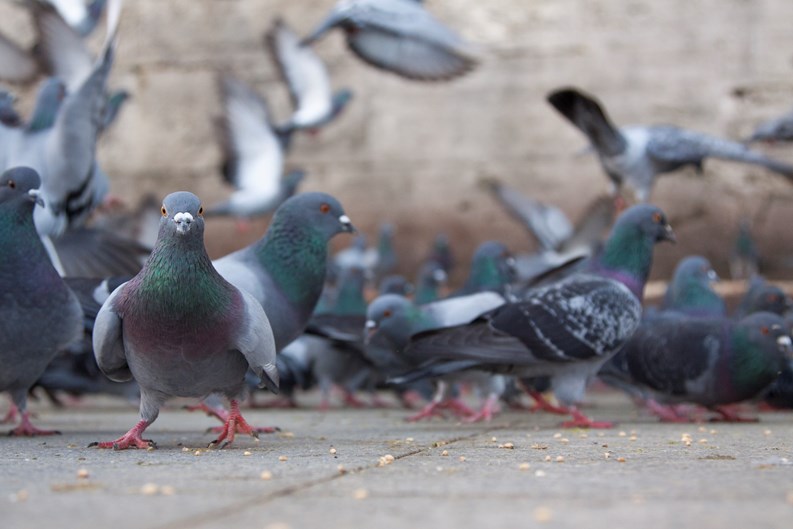
When it comes to animals we humans consider to be pests, insects and rodents are usually the first critters that come to mind. Roaches and rats are as much a part of metropolitan life as sidewalks and street noise—but they’re certainly not the only species whose presence in a multifamily building or HOA can spell trouble. Certain types of birds can also make pests of themselves in both urban and suburban communities, and getting rid of the feathered invaders can be every bit as challenging as eradicating an infestation of bedbugs or mice.
A Health Hazard
Birds aren’t as likely to trigger disgust as bugs or rodents, but just because they’re comparatively cute and usually docile doesn’t mean they’re harmless.
The problem, in a word, is poop. According to the New Jersey Department of Health, accumulated bird droppings can trigger allergic reactions and lead to a host of health problems for both humans and pets—some of which can be deadly. Bird droppings carry loads of bacteria, as well as parasites that can infiltrate people’s homes—and lungs—if there’s a nest near an open window, fan, or air conditioner. According to Assured Environments, a pest control company serving multifamily properties in New Jersey, New York, and Connecticut, “Birds themselves are a vector for disease. Their feathers, droppings, and nests can all contain potentially dangerous pathogens [like] salmonella, meningitis, tuberculosis, and encephalitis. Combine pigeon fleas, parasites, and diseased feces with an infestation, and you’ve got an extremely bad, possibly disastrous situation.”
Beyond Gross
In addition to disease, bird droppings can also cause physical damage to buildings and other property. According to the pros, droppings contain uric acid and ammonia, which eat away at building materials, causing corrosion and deterioration. As time goes on, this damage can compromise roofs, erode facades and siding, break down painted surfaces, and cause further damage by clogging drain pipes, vents, and external HVAC equipment, leading to costly repairs. “The acid in droppings causes damage to metal,” says Gil Bloom, entomologist and president of Standard Pest Management based in Queens. “It will even shut down a distribution system” by corroding pipes and other infrastructure.
Assured Environments concurs, adding that “droppings can severely degrade a steel building’s components and cause substantial structural damage. If an infestation is not removed in a timely manner, the corrosive droppings will not only dissolve building material, but they will encourage fungal growth in the soil, leading to diseased grass, trees, and landscape plants.”
This all leads to increased cleaning and maintenance costs, not to mention the costs to repair or replace damaged mechanisms and structures. The safety, sanitation, and health hazards caused by bird droppings can also be a liability risk, and the droppings, feathers, and nest debris they leave behind are simply not a good look, and can negatively affect property values.
The Goose is Loose
While smaller birds are the prime concern for urban high-rise buildings, more suburban condos and HOAs with lawns or adjacent golf courses may find themselves facing a heftier avian adversary: geese.
New Jersey sits squarely along the Atlantic Flyway, one of the major routes used by the Canada goose as it travels between breeding grounds in Canada and wintering areas farther south. However, many Canada geese no longer migrate at all, having adapted to year-round life in suburban and urban landscapes like Hoboken and Jersey City. With plentiful lawns for grazing and nearby water for safety, these environments support large resident populations—so even outside migration seasons, geese remain a constant and often conspicuous presence across the region.
Like their much-smaller brethren, geese carry all kinds of pathogens and parasites—and if a flock is large enough, it can even contaminate water supplies. Even if they’re just passing through, geese can eat lawn grass down to a nub, costing thousands in reseeding and sodding fees; they loiter on any available green area, leaving their droppings and feathers everywhere and discouraging residents from using the spaces they’re paying for. On top of all that, geese are extremely territorial, and have been known to attack adults, children, and pets who get too close, biting, hissing and battering the target with their huge wings. According to a 2021 ABC 7 news report, a man in Woodland Park, New Jersey was knocked to the ground and savagely pecked by a male goose guarding its nest, leaving the man’s face badly bruised and covered with scratches.
Get the Flock Out
So what can a building or HOA do to discourage pest birds from turning their property into a guano-spattered hazmat site? According to the pros, there are three main options: exclusion, perch removal, and behavioral adjustment.
Exclusion usually takes the form of a netting barrier that simply prevents birds from accessing potential roosting spaces in the first place. The upside of this approach is that it’s relatively inexpensive, permanent, and humane. “Netting is the main method we use to prevent the birds from continuing to land, nest, or loaf,” says Bloom. The downside is that the netting might be an eyesore, depending on how visible it is on the property.
Perch removal involves installing devices like spikes, traps, or wires to prevent birds from landing on a surface. While this might not be practical for every nook and cranny of a building, it’s often a good solution for a limited area like a railing or an awning. “Another material we use creates a visual disturbance as birds are trying to land, like reflective strips, mylar tape, and laser lights,” says Bloom.
Behavioral adjustment uses deterrents like cutouts of fake predators (including owls or cats), lasers, high-frequency ultrasonic deterrent devices, and low-voltage electric shocks to train birds to avoid certain areas without physically harming the birds. The low profile and non-lethality of the equipment make it an attractive option for communities who love animals—even pesky birds—but who aren’t okay with having their property taken over by Mother Nature’s squawking or honking hordes.
Shooing geese away from your grounds can be more delicate than evicting a flock of pigeons or starlings. Like most wild migratory birds, geese are protected under federal law, says says Rebecca Fyffe, a wildlife educator and Director of Research at Landmark Pest Management in Chicago, meaning “you can’t disturb the nest of a protected bird, or take their eggs or young away” without a license and legal permit; doing so can cost tens of thousands of dollars in fines. That’s why it’s vital to contract with a professional who’s a National Pest Management Association (NPMA) member and familiar with the latest legal methods for removing geese. Those methods might include motion-activated water sprayers that squirt birds as they attempt to land, or putting fences around ponds can convince the geese to move elsewhere.
Avian pest pros agree that ultimately, the key to successful bird control is prevention—and that begins with making your property less attractive to feathered guests. As with any pest, the first step is to stop feeding them. A strongly enforced, association-wide rule outlawing feeding pigeons, geese, and other wild animals—along with a hefty fine to back it up—is a good way to start. Bloom adds that managers and boards can enlist residents to do their part by reminding them that pigeons are pests, not pets. “Some people think it’s okay to let them stay because they’re cute,” he says, “but then you’re going to have a lot more before you even realize it. The best thing is to not give them a sheltered harborage location.”
Building staff can also make small changes to help keep the pest bird population under control. According to Lenny Bilski, owner of Emergency Environmental Control on Long Island, simply ensuring that garbage can lids are secured properly and that trees and plants are trimmed back from your building can help, as can eliminating gaps underneath window air conditioning units that might be appealing roosts.
Bye-Bye, Birdies
The cost of a bird control program can vary widely, depending on the severity of the issue and the scope of the solution. Minor services like inspections, nest removal, and limited deterrents can run from a few hundred dollars up to around $2,000 for a mid-sized building. These are generally short-term fixes suited to isolated problems rather than ongoing infestations.
For more long-term mitigation measures like those mentioned above, the tab is likely to be closer to $2,000 to $8,000, depending on the size of the property, façade complexity, and access requirements. And the higher and less accessible the location, the higher the price tag. As Bloom explains, “We’ve used 60-80 foot booms to get to bird locations, and when you get to those heights, you have to get permits. You may even have to close parts of the street, and it takes a long time between setup and take down of equipment.” It all has to get done in a timely way because, depending on the location, leaving equipment up could be dangerous or get in the way.”
In dense urban environments like Hudson County, costs often trend higher due to labor, equipment needs, and the prevalence of persistent pigeon activity, and more complex conditions can push costs well beyond that baseline. For large properties, or those facing serious or recurring issues, a comprehensive bird management program including property-wide deterrent systems, clean-up, and ongoing monitoring may be what’s called for. These programs often require an upfront investment of anywhere from $5,000 to $15,000 or more, with annual maintenance contracts ranging from several hundred to a few thousand dollars.
According to one property manager, “Once you have a problem, it’s non-stop.” He adds that his firm contracted a no-kill pest control company to repel the invaders at one client community, ”But these firms cost quite a bit of money. It’s not $500; it can be as much as $7,000 or $8,000 to take care of something like this. And you have to deal with it.”
And unfortunately, addressing the issue at one building often creates a new issue for its neighbors, as an evicted flock can just relocate next door. “Sometimes there’s construction, or a property will be doing bird exclusion,” says Bloom, “and the birds have to go someplace, right? There’s an endless number of places they can go in cities.”
While there’s not a catch-all solution for bird problems; it may take a couple of tries to find what works best for your community, and sometimes a problem requires a combination of measures to solve. The best approach to minimizing negative effects on your property and residents is a diversified one of vigilant maintenance, deterrence, and cooperation between residents and building staff. With patience and ingenuity, your community won’t go to the birds.




Leave a Comment